
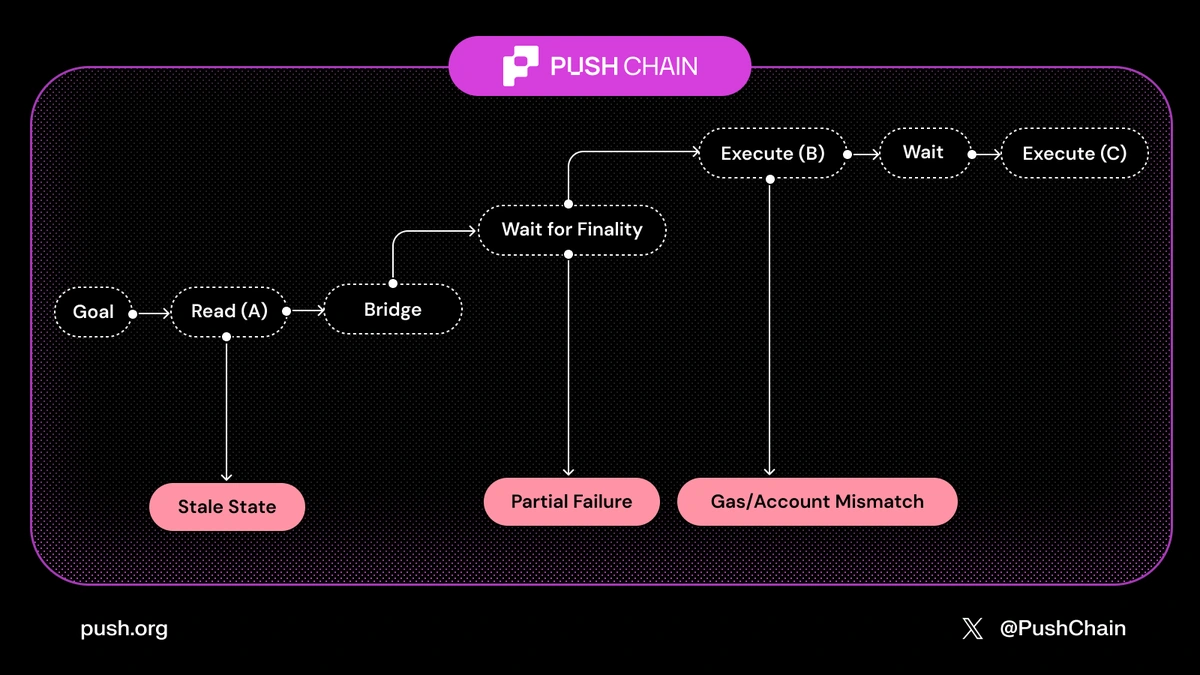
A regular cross-chain agent (today)
Let's say the objective is to rebalance, lend, and hedge. What it actually has to do:
- Read state from multiple chains (each with its own latency + finality assumptions)
- Route funds through bridges/message passing (often asynchronous)
- Manage multiple gas tokens + accounts
- Handle partial completion (step 1 succeeds, step 2 fails). The worst outcome for automation
Not only are these steps time-consuming, but they also introduce multiple points of failure:
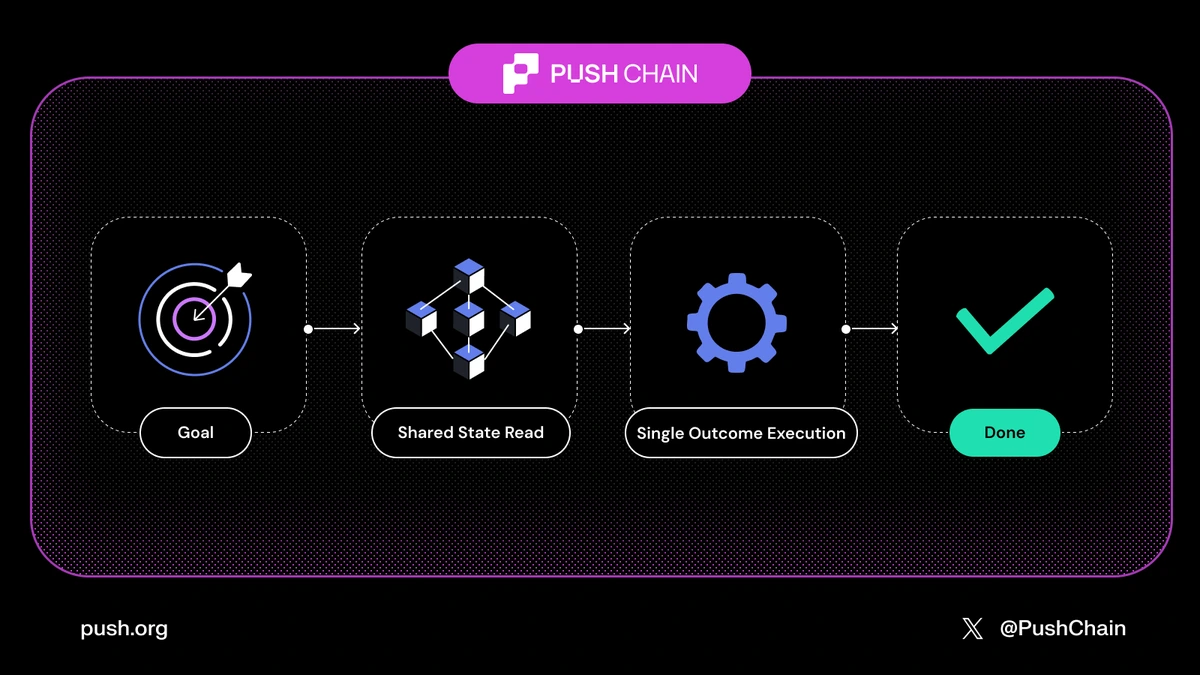
A shared-state agent (also possible today)
'Shared state' is a unique feature of Push Chain through which its smart contracts have the ability to read state from any supported chain and perform an action based on that.
Here the goal is the same. But the environment is different:
- The agent gets to read from a single coherent state surface
- It executes as one outcome-driven plan
- Fewer moving parts → fewer failure modes
If you're building "agent-ready" apps on Push Chain, you can assume a world where the agent doesn't need to be a bridge operator or a chain router.
Universal Transactions
One of the mechanics that makes this possible on Push Chain is the Universal Transaction — a primitive that lets you bundle multi-chain intent/logic into a single atomic executable action.
With universal txns, the agent can express a plan (approve → swap → deposit, etc.) and execute atomically with no partial failure.
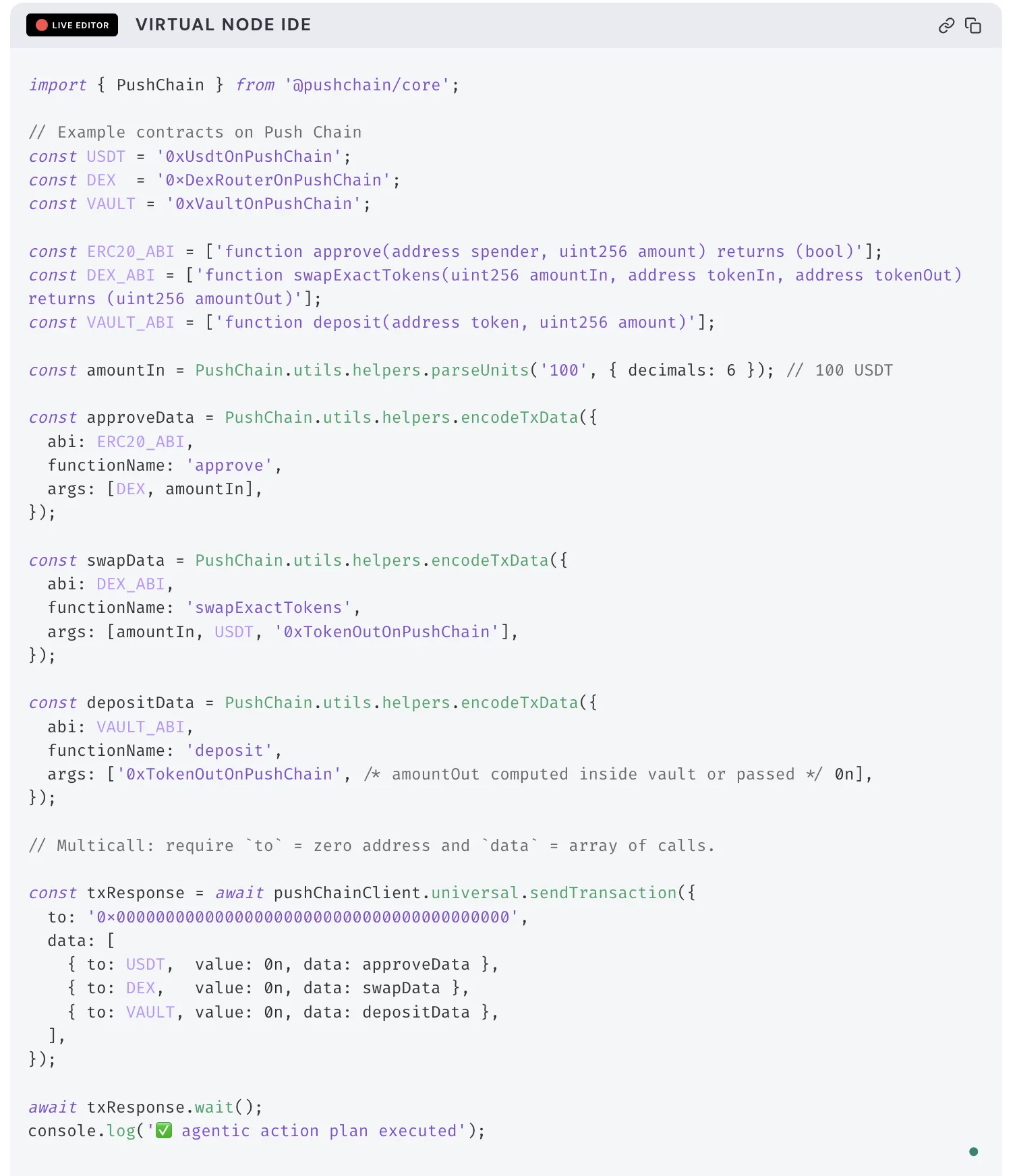
What happens here:
-
The agent ABI-encodes three onchain actions (approve → swap → deposit) using
PushChain.utils.helpers.encodeTxData, so each step is a deterministic payload. -
It submits a single
pushChainClient.universal.sendTransaction()where"to"is the zero address and"data"is an array of{ to, value, data }calls, which is the Push Chain multicall format. -
Push Chain executes those calls atomically on the user's Universal Execution Account (UEA): either all three succeed, or the whole batch reverts (no partial completion).
-
From agent's perspective, this turns a fragile cross-chain "sequence of transactions + confirmations" into one outcome-driven transaction with one hash and one confirmation path.
Why this matters for agents
With universal transactions:
- The agent doesn't orchestrate multiple chains manually
- Reads and writes behave as if there's one state
- Outcomes become predictable instead of fragile
This drastically reduces failure modes that plague agents in today's fragmented environment.
Want to experience how it feels to transact universally? Explore our Universal App Ecosystem here: https://push.org/ecosystem/