
Picture This: You want to build a cross-chain DeFi app accessible from Ethereum, Arbitrum and Solana.
Here's what you actually have to do:
- Integrate different wallet adapters
- Add new providers
- Tackle between different account models
- Look after key management and so much more
That's spending more time on plumbing the infra than building the app! The best infrastructure is always invisible.
Universal Signer makes your cross-chain infra invisible. You keep the signer you already use today (Ethers, Viem, Solana Web3, etc.) Push just wraps it into a Universal Signer and makes it speak "universal" under the hood.
What pain does it kill?
Without Universal Signer, you'd normally:
- Maintain different wallet flows per chain
- Treat Solana / EVM / L2s as separate worlds
- Glue bridges + RPCs + signature formats by hand
- Rebuild the same "connect → sign → send" logic N times
With Universal Signer:
- You pass in one existing signer
- Push maps it to a Universal Executor Account (UEA) on Push Chain
- That account becomes your app's universal execution identity
- All the routing, gas, and cross-chain glue is done for you
You still code like it's a normal app. And focus your energy where it matters the most — your app's features.
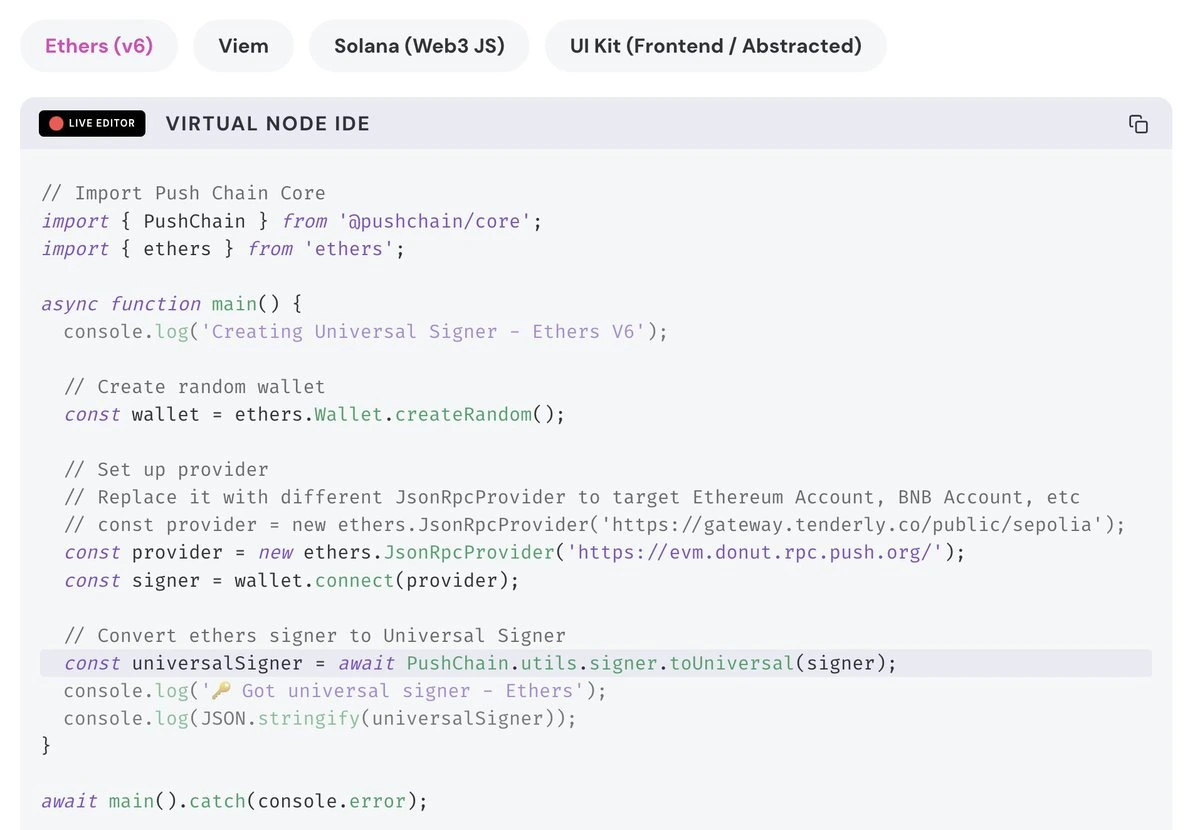
The Magic of toUniversal()
When you call:
const universalSigner = await PushChain.utils.signer.toUniversal(signer);
This is what happens under the hood:
1. Signature Scheme Detection
Push Chain detects:
- if (signer is ECDSA) → EVM chains (Ethereum, Polygon, Arbitrum, etc.)
- if (signer is Ed25519) → Solana, Cosmos, etc.
2. Chain Origin Identification
Push Chain reads RPC provider and determines whether the calling rpc network is Ethereum Sepolia, Solana Devnet or Push Chain itself.
3. And Verifies the Signature Format
- The user never leaves their wallet of choice
- The app never re-implements cross-chain logic
- The chain handles all the ugly bits (bridges, proofs, gas conversions, settlement)
For users the UX remains the same:
- Use the wallet they already trust
- Stay on their home chain
- Still interact with Universal Apps running on Push Chain
How it fits into your app's flow
Think of your flow in three layers:
1. Wallet / Signer — Whatever you already use today
- Ethers Wallet + Provider
- Viem walletClient
- Solana Keypair
2. Universal Signer (Push) You wrap that signer once: "Hey Push, this is my user. Make them universal."
3. Universal Client + Transactions
Now your calls like universal.sendTransaction(...) automatically route from that user on that chain → Push Chain.
As a Developer, Here's What You DON'T Write:
❌ Chain Detection Logic ❌ Signature Verification ❌ Gas Estimation Across Chains ❌ Settlement Tracking
same signer → new superpowers.
The best infrastructure is invisible. Developers shouldn't think about chains — they should think about apps and its features.
Build Universal Apps in weeks, not months — push.org/docs