
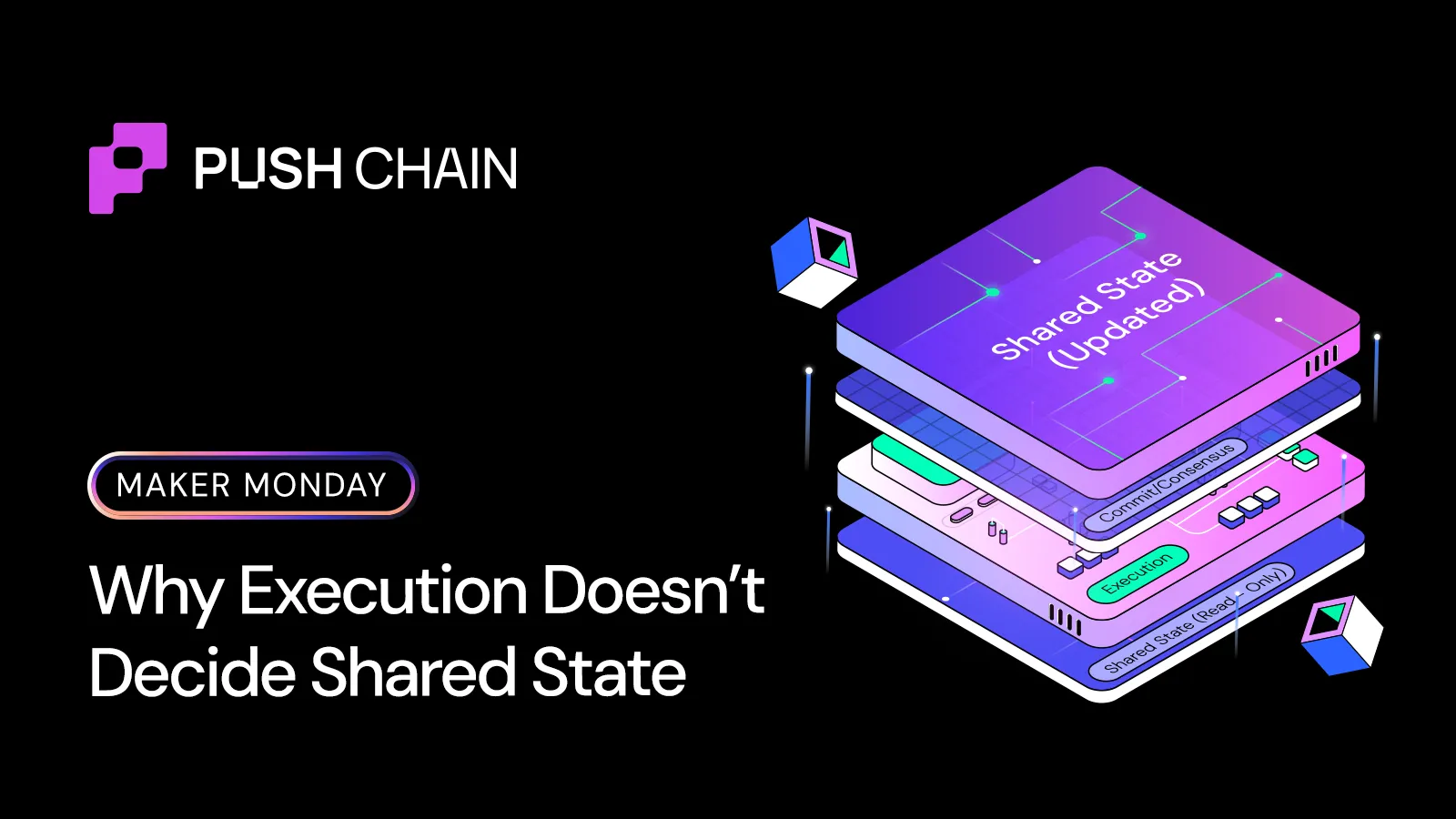
“Shared State” sounds risky, and that instinct is correct.
If execution happens across chains, what stops?
→ partial updates
→ reorg bleed-through
→ inconsistent global state
Not all chains finalize blocks the same way
Different chains provide different levels of finality:
Deterministic style finality
- Once committed, blocks are effectively irreversible
- Confirmation is certain
- Reorg risk is negligible
Probabilistic finality
- Blocks can be reorganized within a window
- Early confirmations are not absolute
- Finality strengthens over time
This difference is where most cross-chain complexity begins.
How Push Chain separates execution from state
Push Chain enforces a strict rule:
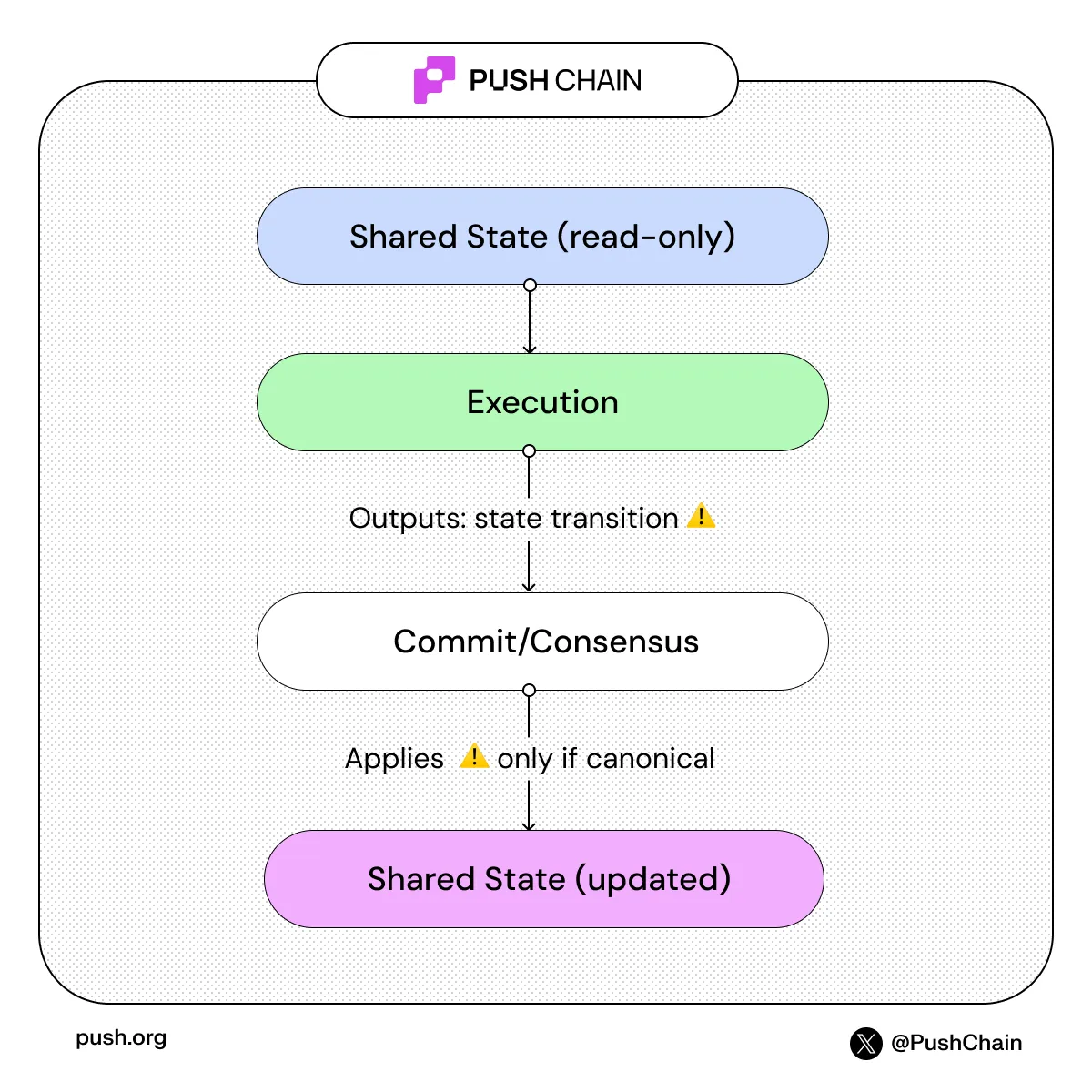
Execution cannot directly mutate Shared State.
Execution can:
- read shared state
- run logic
- compute outcomes
But it cannot commit state changes directly. Only canonical block commits can update Shared State.
The mental model
Think of execution as a sandboxed simulation:
- Transactions propose changes
- Execution computes the result
- But nothing is applied yet
Only when a block becomes canonical:
- Results are committed
- Shared State is updated
If a block is dropped or reorganized:
its effects never enter the canonical Shared State
Where risk is actually handled
Shared State does not mean shared risk.
Push Chain handles risk before state is committed, not during execution.
Transactions can be handled differently depending on:
- value sensitivity
- finality characteristics of the source chain
At a high level, this creates two modes:
- Fast path (UX-first, bounded risk)
Used for:
- lower-value interactions
- cases where instant UX matters
How it works:
- execution proceeds without waiting for deep finality
- reorg risk is bounded at the protocol level
- safeguards limit worst-case exposure
Result:
- near-instant user experience
- controlled, limited risk
- no corruption of Shared State
- Finalized path (risk-minimized)
Used for:
- higher-value transactions
- environments with probabilistic finality
How it works:
- waits for sufficient confirmation depth
- execution results are committed only after strong finality
Result:
- slower than fast path
- negligible reorg exposure
- fully stable canonical state
What happens when things go wrong?
Reorgs
- Non-canonical blocks are discarded
- Their execution results are ignored
Shared State reflects only the surviving canonical chain. No partial updates. No global drift.
Execution failures
If execution reverts:
- No canonical commit
- No state transition
- No cross-chain inconsistency
Execution failure ≠ state corruption.
Why this distinction matters
Shared State does not mean:
- shared execution risk
- shared failure modes
- shared reorg exposure
Instead:
- execution is isolated
- risk is handled before commit
- state updates happen only through canonical consensus
That’s the difference between:
“Everything touches everything,” and “everything resolves through one authority.”
Takeaway
Even in a multi-chain environment:
- execution can fail
- chains can reorg
- transactions can be reordered
But Shared State remains predictable, consistent, and corruption-resistant
Because execution never had the authority to mutate it in the first place.
Try it before trusting it. The boundary is visible at the client layer.